
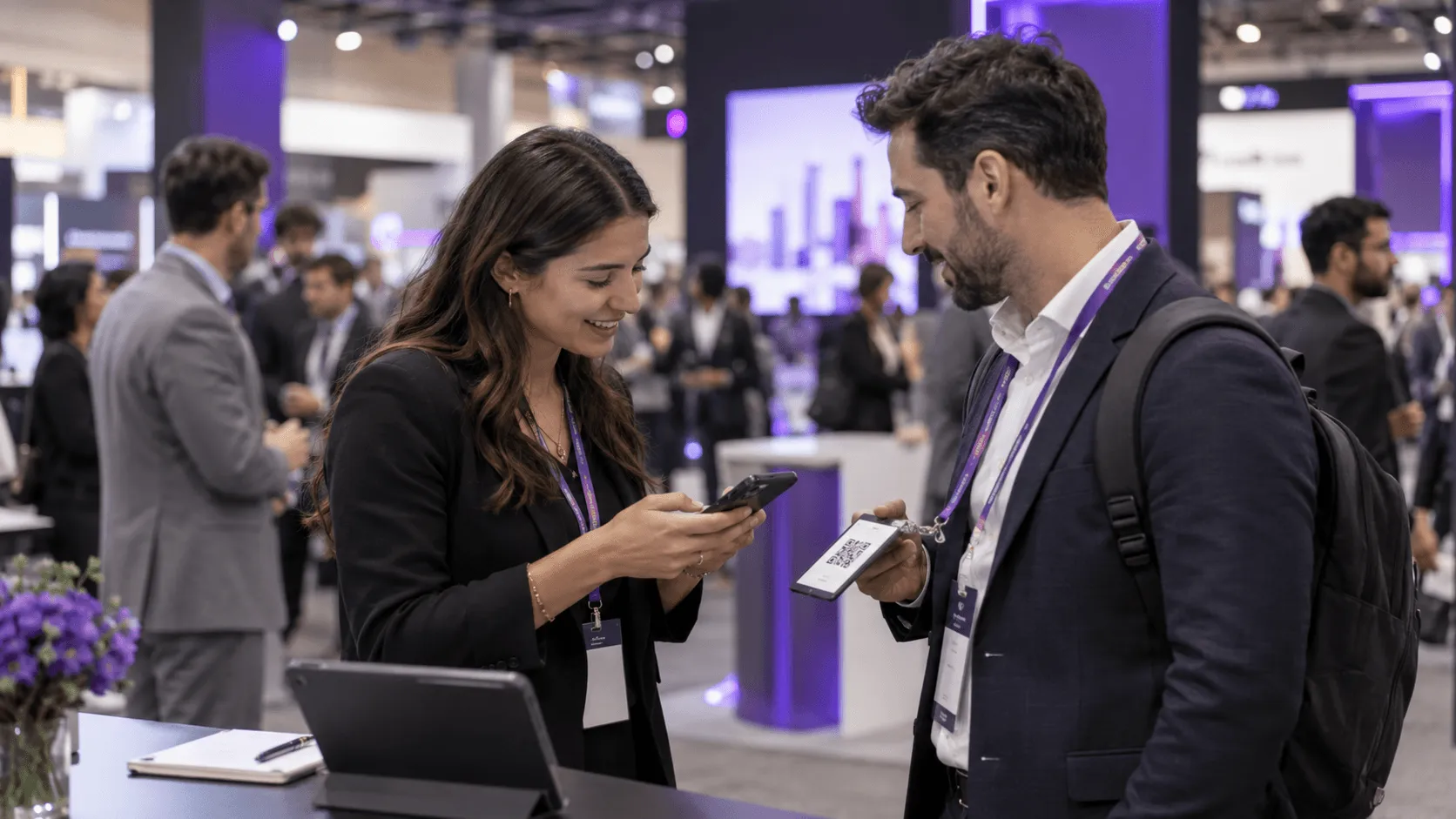
Trade show lead generation ideas work best when they do more than attract booth traffic. The strongest ideas help you identify the right visitors, start useful conversations, capture context with each lead, and make the next sales action obvious. A crowded booth can look successful while still producing very little pipeline.
What actually makes a good trade show lead generation idea?
A good trade show lead generation idea should do at least one of four jobs:
That distinction matters because trade show teams often measure the easiest thing to count: scans.
A scan proves someone was physically close enough to your booth to exchange data. It does not tell you whether they fit your ideal customer profile, what problem they have, how urgent it is, or what should happen next.
For exhibitors, the goal should not be "collect more leads." It should be "leave with more useful sales conversations that your team knows how to continue."
If you are working on lead generation beyond a single event, this guide on how to generate leads for your business covers the wider funnel.
That is also why the best trade show lead generation plan starts before the booth opens and ends after the show closes.
Which trade show lead generation ideas are worth trying?
Here are 15 ideas, grouped by the job they do rather than by how flashy they look.
The point is not to use all 15.
Choose ideas based on where your current process breaks.
If your booth is empty, fix attraction. If it is busy but sales says the leads are poor, fix qualification. If good conversations get lost after the show, fix capture and follow-up.
How can you generate trade show leads before the show starts?
The easiest lead to talk to onsite is one who already expects to meet you.
That is why pre-show lead generation deserves more attention than another booth gimmick.
1. Build an ICP-based target list
Start with the type of company and buyer your sales team actually wants.
Define the basics:
- Industry
- Company size
- Job role or buying influence
- Geography
- Known problem or use case
- Existing account status
Then build your outreach list from the attendee list, exhibitor directory, partner network, existing CRM contacts, LinkedIn, or accounts already showing buying intent.
Do not make the list as large as possible. Make it useful enough that a rep can recognize the accounts that matter.
2. Pre-book short meetings
Instead of sending "come visit us at booth 417," give the prospect a reason to spend 15 or 20 minutes with you.
The reason could be:
- A tailored product demo
- A benchmark review
- A mini consultation
- A product preview
- Access to a specialist
- A short assessment of their current process
The meeting request should answer one question: why is this worth time during a packed trade show day?
CEIR research found that 94% of surveyed attendees did some form of pre-event planning and 56% searched the exhibitor directory to identify booths to visit. The research is older, so these numbers should be treated as historical rather than a 2026 benchmark. The useful point is that booth discovery can begin well before attendees reach the show floor.
3. Turn your speaker slot into a booth lead source
If someone from your team is speaking, do not end the session with a generic "visit our booth."
Give attendees a concrete continuation.
For example:
"Bring your current lead capture workflow to booth 417. We'll show you the three places leads usually get lost."
That connects the educational session to a useful next action.
The same principle works for panel appearances, workshops, sponsor sessions, or roundtables.
How can you attract the right people to your trade show booth?
More foot traffic is not always better.
A crowded booth full of people waiting for a free gadget can stop a serious buyer from entering.
Your booth should make the right visitor think, "This is for me."
4. Replace product-first messaging with problem-first messaging
Compare these two signs:
"AI-powered revenue intelligence platform"
versus:
"Still waiting three days to find out which trade show leads were worth calling?"
The second gives a visitor a reason to self-select.
Strong booth messaging usually names:
- The problem
- The audience
- The outcome
Keep it readable from the aisle. The booth should start the conversation before a staff member does.
If getting people to stop is the main problem, these trade show booth ideas focus specifically on creating a booth people notice and want to enter.
5. Run a 3-question diagnostic
A short diagnostic gives people a reason to participate and gives your rep a natural qualification path.
A cybersecurity exhibitor might ask:
- How many endpoints do you manage?
- Where does your biggest visibility gap sit?
- Is fixing it a 2026 priority?
A marketing technology exhibitor might ask about CRM, campaign volume, and the reporting gap they want to solve.
The result can recommend a relevant demo, content asset, expert, or next step.
This works better than a generic quiz because the interaction creates sales context.
6. Offer a live personalized demo
Trade show demos often fail because they become a five-minute product tour that every visitor receives.
Instead, ask one qualifying question before the demo:
"What are you trying to fix?"
Then show the smallest part of the product that answers that problem.
For a high-volume booth, create two tracks:
This prevents a long product walkthrough from becoming a queue problem.
7. Host expert office hours
Not every lead wants a product demo.
Some visitors would rather ask an expert about a problem they are already working on.
Offer fixed office-hour blocks such as:
- "Ask a RevOps expert"
- "15-minute booth design teardown"
- "Bring your event lead workflow"
- "Ask an engineer"
Promote the time slots before the show and let people reserve them.
This approach works best when the expert can genuinely help without turning every answer into a pitch.
8. Use a giveaway that filters instead of just attracts
Giveaways are not automatically bad. Irrelevant giveaways are.
An expensive gadget can create a line of people who want the prize and have no interest in your company.
A better giveaway is connected to the audience or interaction.
Examples:
- A useful industry book after a short assessment
- A premium consultation for one qualified participant
- A product-specific kit
- Access to research or a benchmark report
- A donation triggered by completing a relevant activity
Ask: if we removed our logo, would the ideal buyer still want this?
If the answer is no, it may be swag rather than lead generation.
9. Build a competitive challenge around the problem you solve
Games can work when the game reveals something useful.
A logistics company might run a routing challenge. A cybersecurity company could run a threat-spotting test. A data company could ask visitors to find bad records. An event technology company could challenge exhibitors to qualify and route sample leads under time pressure.
The interaction gives you an easy conversation starter and can create a natural data capture moment.
If you want to build games into the booth experience, these event gamification ideas show how challenges, points, and rewards can be tied to actual participation instead of being entertainment for its own sake.
How should exhibitors capture and qualify leads onsite?
This is where many good booth conversations become bad CRM records.
A name, email address, and company are not enough.
Sales needs to know what happened.
10. Use QR codes for simple, fast lead capture
QR codes work well when visitors need a low-friction way to:
- Request a demo
- Download a useful asset
- Join a waitlist
- Enter a relevant activity
- Share contact details
- Book a follow-up
Keep the mobile form short.
If the visitor has already had a conversation with a rep, do not make them type ten fields your team could capture another way.
QR capture is especially useful at smaller booths or side activations where dedicated lead retrieval hardware would be unnecessary.
For more ways to use them across registration, content, networking, and onsite experiences, see this guide to using QR codes for events.
11. Pair badge scanning with qualification fields
At a large trade show, badge scanning is fast. The weakness is what happens after the scan.
If every record looks the same, sales has to reconstruct the conversation days later.
Add a few qualification fields such as:
- Use case
- Purchase timeline
- Product interest
- Account fit
- Decision role
- Follow-up action
The capture experience should be quick enough to use while the conversation is still happening.
For organizers who want lead capture, exhibitor visibility, and sponsor interactions to sit inside the same event system, Nunify's event sponsorship and exhibitor solutions are designed around that workflow.
Its Small Business Expo case study gives a good example of richer lead capture in practice.
Across the program, Nunify reports 190,000 leads generated across 16,000 exhibitors. Exhibitors could scan visitor badges, score leads as Hot, Warm, or Cold, and attach notes or voice memos while the conversation was fresh.
That matters because the scan and the sales context stay together.
12. Score leads while the conversation is fresh
Do not wait until the flight home to decide which leads mattered.
Use a simple scoring model the whole booth team understands.
You can use letters, numbers, tags, or a more detailed lead-scoring system.
The important thing is consistency.
"Hot" should mean the same thing to every booth rep.
13. Capture one sentence of context with every important lead
If your team adopts only one idea from this article, make it this one.
After a meaningful conversation, capture one sentence:
"Runs 12 regional shows, using spreadsheets today, wants a lead retrieval option before Q1 kickoff."
That sentence makes the follow-up easier to write, helps another sales rep understand the lead, and preserves details that disappear after dozens of booth conversations.
Voice notes can make this easier in a busy environment.
The hidden cost of most lead capture systems is not the scanner fee.
It is the loss of context when the system is optimized for speed but not memory.
How can you turn a booth conversation into the next sales action?
Lead generation should not end with "we'll be in touch."
The next step should be decided while both people remember why the conversation mattered.
14. Book the follow-up before the visitor leaves
If the person is qualified and wants a deeper conversation, open the calendar.
Book the demo, technical call, assessment, or follow-up meeting before they walk away.
This removes one of the most common post-show failure points: three emails trying to schedule a conversation that both sides already agreed should happen.
For a high-intent lead, a booked meeting is a better output than a badge scan.
15. Route leads by what they asked for
Not every lead should receive the same email.
Route follow-up based on intent.
The easiest way to make post-show email feel personal is to capture the reason for the conversation in the first place.
What can trade show organizers do to help exhibitors generate better leads?
Lead generation is not only an exhibitor problem.
If you run the trade show, expo, or exhibition, the quality of your lead retrieval setup becomes part of the exhibitor experience.
Exhibitors are paying for access to an audience. They need a practical way to turn that access into evidence they can take back to their sales and marketing teams.
For organizers running shows in the US, Dubai, or the UAE, this can become part of the exhibitor package rather than an afterthought.
Give exhibitors a lead capture workflow that lets them:
- Scan an attendee QR code or badge without adding another disconnected tool
- Add qualification tags and notes immediately
- Score the lead while the conversation is fresh
- Export their own lead data
- See digital booth interactions where relevant
- Connect the lead file to the systems their sales team already uses
This changes the conversation from "How many people attended?" to "What value did each exhibitor actually get?"
The Small Business Expo case study shows this at a much larger scale. The event app combined attendee badge QR codes with an in-app exhibitor scanner. Exhibitors could score leads and record notes or voice memos, while the organizer could offer a repeatable lead retrieval experience across thousands of exhibitors.
That creates a second level of lead generation data.
The exhibitor sees the individual prospects they captured.
The organizer can understand whether the event is helping sponsors and exhibitors create measurable interactions.
That matters for renewals.
An organizer trying to sell next year's booth package has a stronger story when the conversation includes leads, interactions, and exhibitor activity rather than attendance alone.
It also means interactive event ideas can do more than entertain.
A scavenger hunt, booth challenge, sponsored session, or QR-based activity can be designed so the interaction creates a useful signal for an exhibitor or sponsor.
The rule is the same: do not collect data because you can. Decide what action the signal should enable.
What trade show lead generation ideas usually fail?
Several popular tactics can produce activity without producing much value.
A giveaway with no qualification
If anyone can scan a code to win a high-value prize, you have created a prize-entry database.
That may be useful for awareness.
Do not automatically treat it as a sales-lead list.
Scanning every person who walks past
A badge scanner can make volume feel productive.
But if booth staff scan people without speaking to them, qualification gets pushed downstream to sales.
You have saved seconds onsite and created hours of cleanup later.
A booth game that has nothing to do with your offer
A racing game, claw machine, or spin wheel can pull a crowd.
That can be useful if your problem is visibility.
It becomes weak lead generation when the only connection to your company is the logo on the screen.
The fix is not to kill the game. Add a transition from the interaction to a relevant question or next action.
Sending the same follow-up to everyone
"Great meeting you at the show" is easy to automate and easy to ignore.
A useful follow-up should remind the person what you discussed, give them what they asked for, and make the next step clear.
CEIR has long emphasized follow-up planning, ownership, speed, and repeated contact after exhibitions. The specific channel can vary. The useful lesson is to decide who owns follow-up before the show, rather than after the lead file arrives.
When do you not need another trade show lead generation tactic?
Sometimes the answer is not another idea.
Do not add a new booth activation when:
- Your team already has strong traffic but cannot qualify visitors.
- Good leads are captured but nobody owns follow-up.
- Your reps use different definitions of a qualified lead.
- Data sits in a scanner export for days before entering the CRM.
- Your booth promise and sales conversation do not match.
- You cannot explain which trade show leads became meetings, opportunities, or revenue.
In those cases, fix the handoff.
A simpler booth with a clear message, a good conversation, consistent lead scoring, and a booked next step can outperform a more expensive booth full of disconnected activities.
How should you measure trade show lead generation?
Start by separating activity metrics from business outcomes.
Also track conversion between stages.
Qualified lead rate = qualified leads / total captured leads
Meeting rate = meetings booked / qualified leads
Opportunity rate = opportunities created / qualified leads
Trade show ROI = (attributed revenue - event cost) / event cost × 100
Use the same definitions across shows.
Otherwise one event may look "better" simply because the team counted leads differently.
UFI reported that exhibitions drew 318 million attendees globally in 2024 and generated €150 billion in direct spending. That shows the scale of the exhibition channel, but industry scale does not prove your booth worked. Your own pipeline data has to do that.
What is the simplest trade show lead generation plan to copy?
If you want a practical starting point, use this seven-step workflow.
You do not need fifteen clever ideas.
You need a system where the idea that attracts someone connects to the conversation, the conversation connects to the data you capture, and the data connects to the next sales action.
That is what turns trade show activity into lead generation.