Event promotion ideas fall into five buckets: your own network, social media, email, partnerships and sponsors, and on-site or in-app tactics. Below are 33 specific ones, grouped by category, plus the timing mistake that makes most of them underperform: starting two weeks out instead of six.
Blog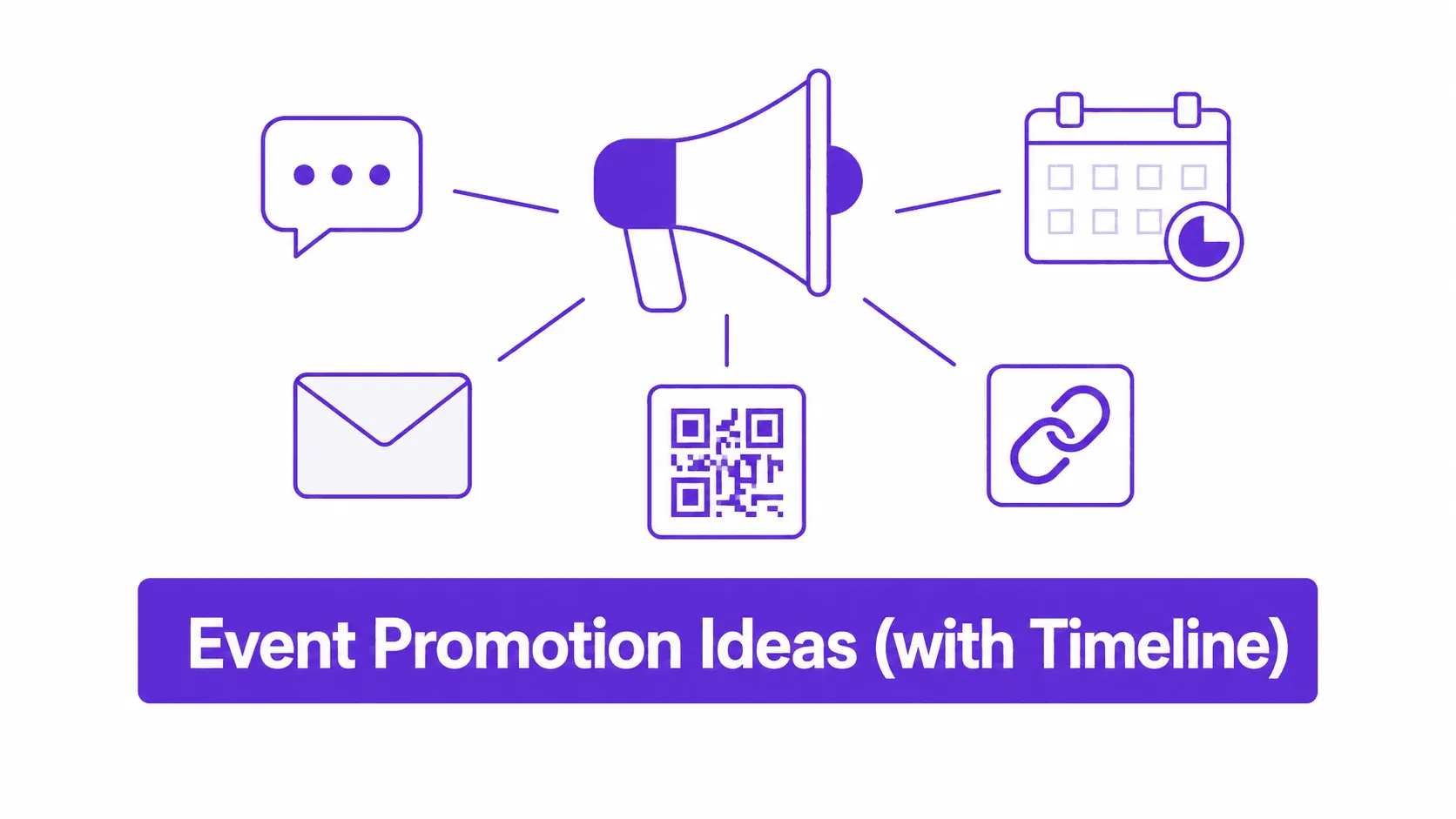
33 Event Promotion Ideas (Plus the Timeline Most Teams Skip)
In this article
- Why Timing Matters More Than the Tactic List
- Awareness Ideas (6-8 Weeks Out)
- Social Media Promotion Ideas
- Email Promotion Ideas
- Ideas That Use Your Own Attendees and Team
- Offline and On-Site Promotion Ideas
- Virtual and Hybrid Promotion Ideas
- SEO and Long-Term Ideas
- Creative and Differentiated Ideas
- Measurement Idea
- How Much Should You Budget Across These Ideas?
- How Does This Change Across the US, UAE, and India?
- When Should You Skip This Entire List?
- What Goes Wrong Even When Teams Use This List
- What Tools Help Track and Run These Ideas?
- FAQs
Why Timing Matters More Than the Tactic List
Most teams start promoting an event two to three weeks out, because that is when the pressure to fill seats starts to feel real. By then, the people most likely to attend have already made their calendar and travel decisions for that window. That decision often happens a month or more out, quietly, without anyone telling you.
This is not an argument for promoting everything for six weeks straight. It is an argument for starting the awareness work early: the save-the-date, the sponsor announcement, the early-bird deadline, before the agenda is even finished. That gives the conversion-focused ideas later in this list an actual audience to work on. A timeline that accounts for this:
The conversion window above is where our 12 event marketing tips to boost RSVPs guide takes over. This list covers everything upstream of that: getting people to know about the event in the first place.
Awareness Ideas (6-8 Weeks Out)
1. Send a save-the-date before the agenda is locked. Waiting for a finished agenda to make the first announcement wastes the weeks when people are still free to block their calendar. Even a one-line email with just the date and format gives people enough to act on.
2. Announce sponsor and partner involvement early. A named sponsor or co-host adds credibility to the very first announcement, before there is a full agenda to sell. It also gives the sponsor more runway to promote the event to their own audience, which is worth more than the logo placement itself.
3. Offer early-bird pricing or early access. A deadline gives people a reason to decide now instead of "maybe later," which for a B2B event usually means never. Pair the deadline with a specific date, not a vague "limited time" line.
4. Create your event hashtag before you need it. A hashtag introduced the week of the event has no history and no reach. Build it into every post and every sponsor ask from week one, so it has a real trail behind it by the time the event starts.
Email Promotion Ideas
13. Build a four-part sequence, not a single blast. Save-the-date, full announcement, urgency reminders, and a logistics email in the final days each do different work. If you run a regular newsletter, the announcement can ride along in an existing send instead of needing its own list-build from scratch.
14. Give each reminder a different angle. A new speaker added, an early-bird deadline, limited seats. Repeating the same message reads as noise by the third send, even to people who genuinely intend to attend.
15. Use the confirmation email as a promotion touchpoint, not just logistics. It is the one email nearly everyone opens, which makes it the best place for a "bring a colleague" ask. Date, time, and a link is not enough on its own.
16. Go deeper on virtual-event email sequencing. Our email marketing tips for virtual event promotion guide covers subject lines and cadence specific to that format. If a webinar is part of the event, the webinar promotion guide covers tactics specific to that audience.
Ideas That Use Your Own Attendees and Team
This is the category most channel-focused lists skip. It does not fit neatly into "social" or "email," and it is often the highest-converting channel available.
17. Add a referral prompt to the confirmation email. A simple "invite a colleague" link converts better than almost any paid channel, because the recommendation comes from a peer instead of a brand account. This is easy to skip since the confirmation email feels like pure logistics, which is exactly why most teams never add it.
18. Segment your list before sending referral asks. A blanket blast underperforms a targeted ask to the people most likely to know someone else who should attend. Past attendees who brought a guest before are a good place to start.
19. Give people something specific to forward. A one-line pitch or a short preview clip gets shared. "Come to our event" does not, since it gives the person nothing concrete to pass along.
20. Track referral signups separately from direct ones. Knowing which segment is actually driving new registrations tells you where to invest next cycle, instead of guessing based on which channel felt busiest. Qzero keeps invite tracking, RSVP status, and ticketing in one place instead of a spreadsheet.
Offline and On-Site Promotion Ideas
21. Build promotion into the sponsorship agreement itself. A specific number of posts or an email to the sponsor's list, written into the contract, converts a vague expectation into something that actually happens. Leaving it as an informal ask means it gets forgotten once the contract is signed. Our event sponsorship guide covers structuring this.
22. Use QR-coded badges and printed materials at partner offices. Especially effective for recurring regional events in Dubai and other UAE markets, where in-person industry networks carry real weight. A physical handout still gets picked up and read there.
23. Pursue local press or industry media coverage for flagship events. Worth the effort for milestone or annual conferences, not for a routine internal town hall, since the credibility payoff takes real outreach time to earn.
24. Prompt attendees to invite a colleague during the event itself. A quick ask at the end of a session or a line on a badge insert costs nothing. It reaches people your list does not, since it travels through a network you never had access to.
Virtual and Hybrid Promotion Ideas
25. Send day-before and hour-before reminders by email or WhatsApp. Registering for a virtual event carries less commitment than an in-person one, so reminder cadence matters more here. A registrant who forgot by the day before is easier to recover than one who never got reminded at all.
26. Promote on-demand availability. Telling people they can watch later if they miss the live session increases registration, even though some registrants will never watch live. Framing it as a safety net removes a common reason people decline to register at all.
27. Write separate messaging for in-person and virtual audiences at hybrid events. One group cares about venue and logistics, the other about stream quality and access. Treating them identically undersells one side of the audience every time.
SEO and Long-Term Ideas
28. Optimize the event landing page for the event name, topic, and location. This compounds for recurring events, since "[event name] 2027" starts getting searched the moment this year's event wraps. The page keeps earning traffic long after the last paid campaign stops running. Our SEO guide for event marketing covers keyword and page strategy for this.
Creative and Differentiated Ideas
29. Run a gamified pre-event contest tied to the badge or app. A leaderboard or small prize for early registration adds a fear-of-missing-out effect that a plain reminder email does not. Works best for trade shows and sales kickoffs where a competitive culture already exists among attendees.
30. Offer an augmented reality (AR) badge preview or branded filter. Costs more to set up than a standard post, so reserve it for flagship annual events.
31. Use attendee storytelling instead of brand copy. A short quote or clip from a past attendee, framed as their story rather than a marketing claim, outperforms polished announcement copy almost every time.
32. Give speakers, sponsors, or industry influencers ready-made shareable assets. A short clip, a quote graphic, a one-line description. It makes it easy for them to promote the event to an audience your own list will never reach.
Measurement Idea
33. Retarget people who visited the registration page but didn't convert. Behavioral retargeting is one of the higher-return paid advertising tactics available, because it targets people who already showed intent. A/B testing subject lines and ad copy across the campaign compounds the same way. Most event platforms, including Nunify, surface enough registration analytics to see which of these 33 ideas actually delivered return on investment. That data matters more than which one just generated clicks.
How Much Should You Budget Across These Ideas?
A rough starting split for a mid-size B2B conference:
If the event leans heavily on sponsor cross-promotion, shift budget away from paid social toward better co-marketing assets for sponsors to use. That reach is often larger and cheaper than a paid campaign. For teams juggling promotion spend alongside venue, catering, and vendor costs, SNAP keeps the promotion budget in the same workspace as the rest of the plan.
How Does This Change Across the US, UAE, and India?
The channel mix that works in New York does not automatically work in Dubai or Bengaluru.
In the US, LinkedIn and email dominate, and corporate audiences respond to direct, professional messaging over anything that reads as a hard sell.
In the UAE, particularly Dubai, WhatsApp is a primary channel, not a secondary one. Reminders and confirmations sent through WhatsApp get acted on faster than the equivalent email, and in-person industry networks carry more weight than in the US.
In India, the same WhatsApp-first pattern holds, alongside heavy reliance on personal referral networks. An invite forwarded by a colleague frequently outperforms a cold company email, which makes idea #17 above especially effective in this market.
Zuno, Nunify's AI attendee assistant, handles reminders across the event app, WhatsApp, and email for exactly this reason. A plan built only around email underperforms in markets where WhatsApp is the default channel people actually check.
When Should You Skip This Entire List?
Nunify data across 200+ events puts the threshold where structured promotion clearly pays off at 75 or more attendees. Below 50, most of this list is overkill. A direct email to a known list and a calendar invite will outperform a multi-channel campaign built for an audience that does not exist yet.
If the event is an internal offsite, a small customer round-table, or a town hall with a guest list you already know by name, skip most of this list. Spend the time on the agenda and the room instead. A known audience does not need a six-week awareness campaign, they already know the event exists.
Save this list for events genuinely trying to reach people who do not already know about them.
What Goes Wrong Even When Teams Use This List
A few patterns show up regardless of how many ideas a team tries.
The promotion plan gets built after the agenda is locked, not alongside it. By the time speakers are confirmed, there are only a few weeks left to compress a six-week plan into two.
Every channel gets the identical message on the same day. It looks efficient, but anyone who follows the brand on more than one platform sees the same graphic three times and tunes it out.
Nobody actually asks the team to reshare anything (idea #11). The single most common miss on this entire list.
The confirmation email gets treated as pure logistics. Date, time, link, done. Skipping the referral ask here wastes the best-performing send of the whole campaign.
Promotion stops the moment registration closes. A team promotes hard for four weeks, hits a strong number, then sends one reminder before the event. Registrants forget, especially for virtual events, and the gap between registered and attended widens. The fix is a short reminder cadence in the final week, not more upfront promotion.
The same 3-4 ideas get used every single event, regardless of format or audience. A team that runs both a 500-person conference and a 30-person internal briefing often promotes both the same way. The smaller one needed almost none of it, and the larger one needed more channels than it got. Matching the effort to the event gets better results than applying the full list uniformly. Idea #29's gamified teaser fits a trade show, not a quarterly team meeting.
What Tools Help Track and Run These Ideas?
QR codes link offline promotion (idea #22) directly to a trackable action. Our QR codes for events guide covers setup for promotion, registration, and check-in.
The event app itself becomes a promotion channel once someone downloads it, through in-app notifications and social sharing prompts. Our guide on promoting your event app on social media covers this side of it. Our event app adoption benchmarks piece covers how promotion timing affects whether people actually use the app once they have registered.
Registration data tells you which of these 33 ideas actually worked. Qzero keeps that data in one place instead of scattered across a spreadsheet, an email tool, and a ticketing platform. For teams running the full stack together, Nunify's event app and event registration software connect promotion, registration, and attendance data in one system.
FAQs
Event promotion usually refers to the specific tactics that get people to know about and register for an event: social posts, emails, ads, partnerships. Event marketing is the broader discipline that also includes positioning, messaging strategy, and post-event follow-up. In practice, most teams use the terms interchangeably.
For most B2B conferences and corporate events, six to eight weeks out is a reasonable starting point for save-the-date and early announcements. Internal events with a known audience need far less lead time, often two to three weeks is enough.
Idea #11: asking your own team and already-registered attendees to reshare the event or invite a colleague. It costs nothing and typically converts better than paid social ads, since the recommendation comes from someone the audience already trusts.
Yes. Virtual events need a heavier reminder cadence close to the event date because registering carries less commitment. In-person events depend more on early lead time for calendar blocking and travel approval. Offline tactics like signage and word of mouth also play a bigger role for in-person events than for virtual ones.
No. Below roughly 50 attendees, a direct email or calendar invite to a known list outperforms a multi-channel campaign. Save the full list for events genuinely trying to reach an audience that does not already know about them.
Social Media Promotion Ideas
5. Post speaker announcements and behind-the-scenes content on LinkedIn. This is the strongest platform for B2B and corporate audiences, especially content that comes from your team's personal accounts, not just the company page. A post from an individual employee typically reaches a different, often more relevant, network than the same post from the brand page.
6. Use Instagram countdown stickers and venue teasers. Works best for brand-forward events with a younger or consumer-adjacent audience, especially in the final two weeks when a visual countdown creates urgency.
7. Run live threads and real-time Q&A promotion on X. Particularly effective for tech events and product launches where a real-time news angle exists, and it works during the event itself, not just before it.
8. Share short, unpolished clips on TikTok. Setup footage, speaker previews, or past-event highlights, kept casual rather than produced. Overly polished content tends to underperform on this platform compared to something that looks native to the feed.
9. Publish speaker previews and past-event recaps on YouTube. Video content builds trust over the weeks leading up to a long-lead conference in a way a single post cannot. It also keeps working as search-discoverable content long after the event date passes.
10. Use Facebook event pages and local group shares. Still effective for community and regional events with an active local Facebook presence. A targeted local ad budget here can reach people who never see the LinkedIn or Instagram posts.
11. Ask your own team to reshare the announcement. Ten people resharing to their own networks reaches more relevant people, faster, and for free, than boosting the same post. Most teams never ask, they just post from the company account and hope.
12. Reuse user-generated content from past events. A clip of last year's crowd or a quote from a past attendee convinces people to register better than another polished graphic. If this is a recurring event, capture this content every time so it is ready for the next promotion cycle.