Blog

Tips for Networking Events: The Event Design Playbook for Planners

Debbie Ashford

July 17, 2026

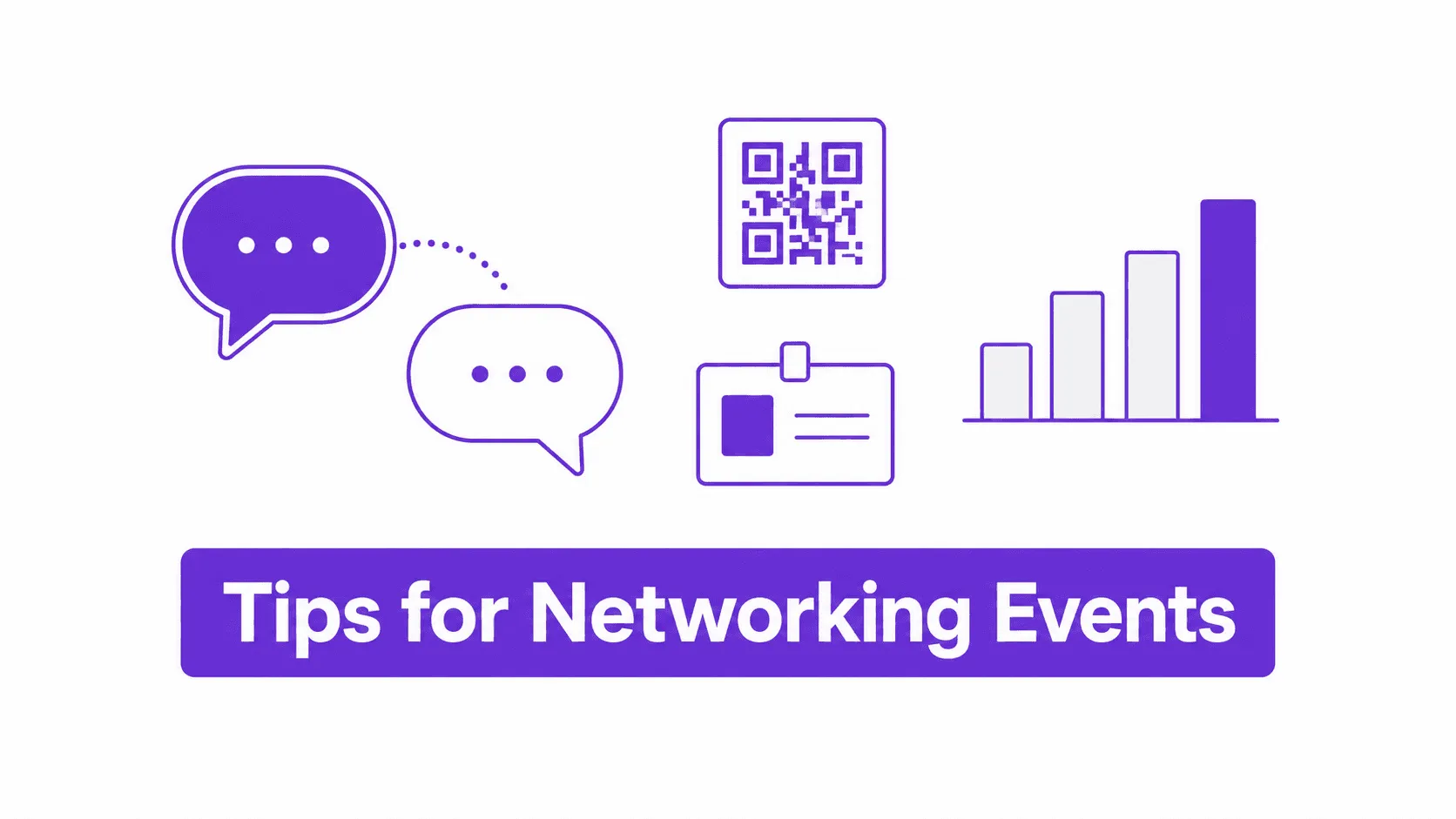
planner-side tips for networking events shown as matchmaking, badge, and analytics icons

The best tips for networking events have nothing to do with elevator pitches or firm handshakes. They are design decisions: who is on the guest list, what format the room runs, how attendees find each other, and what happens in the 72 hours after. This guide covers all of it, from the planner's side of the room.

Most advice on this topic coaches the attendee. Make eye contact. Perfect your pitch. Project confidence. That advice quietly assumes the event itself is fine and the guest is the problem. Usually it is the other way around. A room with no structure, no shared context, and no reason to approach a stranger will defeat even a confident extrovert. A well-designed room makes an anxious first-timer look like a natural.

Why do so few networking events produce real connections?

Because "networking" gets treated as a byproduct instead of a deliverable. The planner books a venue, orders drinks, sends invites, and hopes conversation happens. Sometimes it does. Often you get the familiar failure: clusters of coworkers talking to each other, a few brave souls orbiting the snack table, and a stack of business cards that never becomes a single follow-up email.

The attendee-side symptoms all trace back to design gaps on the planner's side:

What you see in the room

What it actually is

The design fix

People stick to colleagues

No shared context with strangers

Publish attendee profiles before the event

Conversations stall after intros

No conversation starters built in

Structured icebreakers, topic tables

Introverts leave early

Format demands cold approaches

Matchmaking, small-group formats

Cards exchanged, nothing follows

Follow-up left to individual memory

In-app connections, planned follow-up email

Host has no idea if it worked

Nothing was measured

Track connections made, not attendance

Every section below takes one of those fixes and shows how to run it.

What should you plan before anyone walks in?

Three pre-event decisions do more for networking outcomes than anything you do on the day: the guest list, the venue, and pre-event visibility.

Guest list first, headcount second. A networking event's product is the other guests. Fifty attendees from the same buying committee side is a support group, not a network. Curate for complementary profiles: buyers and vendors, seniors and juniors, adjacent industries. Then share the guest list in advance. Attendees who know who is coming arrive with targets, questions, and a reason to skip the small talk.

Venue selection is a networking decision, not a catering one. Standing formats with perch tables produce more new conversations than seated dinners, where your seat neighbor is your whole evening. Match venue size to the list: a half-empty room reads as a failed event and kills the mood before the first handshake.

Make attendees visible to each other early. This is where an event app earns its place. When guests build attendee profiles and get matchmaking suggestions before the event, the awkward "scan the room for someone approachable" phase disappears. Nunify's event networking tools handle this with AI matchmaking, meeting scheduling, and speed networking rules, so first conversations are booked before the doors open. Promote all of this through your event email marketing: profile completion reminders convert directly into matches made.

How do you design a room where conversations start on their own?

You cannot instruct rapport into existence, but you can remove every obstacle to it.

Open with a structured icebreaker, not open mingling. The first 30 minutes set the event's social temperature. Nunify data across 200+ events shows 60-70% of attendees arrive in the first 30 minutes, which means your icebreaker window and your arrival rush are the same window. Plan for it: greeters at the door, a first-impression moment for every guest, and an activity that gives strangers a script. If you need formats, start with these icebreakers for networking events and adapt to your audience.

Give every conversation a starting question. Topic tables, badge prompts ("ask me about..."), and matchmaking suggestions all do the same job: they replace "so, what do you do?" with a question worth answering. Attendees who ask good questions and practice active listening build rapport faster than attendees reciting a pitch, and your job is to make the good question unavoidable.

Retire the business card, keep the exchange. Physical cards get lost, mistyped, and forgotten. QR code exchange inside an event app captures the connection instantly and keeps it attached to the person's profile, their company, and the session where you met.

Contact exchange method

Capture rate

Post-event usability

Business cards

Whatever survives the jacket pocket

Manual entry, often skipped

LinkedIn on the spot

Better, but interrupts conversation

Buried in a generic connection list

QR / in-app exchange

Instant, both directions

Searchable, tied to profiles and follow-up

How do you make networking work for introverts and first-timers?

Networking anxiety is the single most under-designed-for reality in event planning. A meaningful share of your room finds cold approaches genuinely painful, and the standard advice ("be confident!") is useless to them. Body language coaching does not fix a format problem.

Design around it instead:

  • Matchmaking removes the cold approach. An app-suggested meeting with a stated shared interest is a warm intro. Nobody has to break into a circle of strangers.
  • Small-group formats beat open floors. Speed networking rounds, four-person topic tables, and facilitated discussions give introverts a defined role and a defined exit.
  • Gamification gives people a mission. A scavenger hunt or connection challenge turns "walk up to strangers" into "complete the task," which is a much easier social contract. Nunify's event gamification system runs points, badges, and leaderboards for exactly this. One honesty note from Nunify data across 200+ events: if under 30% of attendees engage with gamification after the first hour, the mechanic is wrong for that audience. Watch the number and switch the game, not the goal.

For more formats that do this well, steal from these networking games and event ideas.

Which attendee-side tips are still worth sharing with your guests?

The classics still matter, they are just not your main lever. Fold them into your pre-event email as a one-screen etiquette briefing:

Tip

Why it earns its place

Prepare a short elevator pitch

30 seconds on who you are and the value proposition you bring

Ask questions, then listen

Active listening builds rapport faster than talking

Mind the basics

Eye contact, open body language, a proper handshake, dress for the room

Follow up within 72 hours

A personalized note beats a generic LinkedIn invite every time

Know your goal

"Meet three people in X" beats "work the room"

If you want a ready-made resource to send guests, point them to these networking tips to boost confidence rather than writing your own.

How do you measure whether the networking actually worked?

Attendance is not a networking metric. Nobody came to attend; they came to connect. Yet almost no networking event reports on connections.

Track these instead:

Metric

What it tells you

Connections made per attendee

The core deliverable, directly

Meetings booked (pre-event + on-site)

Whether matchmaking is working

Match acceptance rate

Whether your guest list was actually complementary

Icebreaker / gamification participation

Whether your format fit the audience

Post-event message volume

Whether connections survived the room

With an event app running networking, all of this is captured automatically as attendees match, message, and meet. Without one, you are guessing, and next year's event inherits the guess.

What should happen after the event ends?

The event is the spark; the 90 days after are the relationship. Three moves:

  1. Send the follow-up email within 48 hours. Thank-you, a short feedback ask, and a nudge to complete the connections started in the room. This email is the highest-ROI send in your event calendar and the most commonly skipped.
  2. Keep the connection layer open. If contacts live in the app, attendees can message, share, and book meetings after the room empties. If contacts live in jacket pockets, the event ends when the venue does.
  3. Give the community a reason to return. A monthly digest, a shared space, a next event announced while the last one is still fresh. The second event is easier to fill when the first one never fully ended.

When should you skip networking tech entirely?

Honest answer: below a certain size, you do not need any of it. Nunify data across 200+ events puts the skip-it threshold at under 50 attendees. At that size, a good host, a shared table, and one strong icebreaker outperform any app, and asking 40 people to download software is friction without payoff. The worth-it threshold is 75+ attendees, where nobody can meet everyone and matchmaking, profiles, and analytics start paying for themselves. Between 50 and 75, decide based on how badly you need the data.

Anyone selling you event tech for a 30-person dinner is solving their problem, not yours.

FAQ

  • Curate the guest list for complementary profiles, share it in advance, open with a structured icebreaker instead of open mingling, replace business cards with in-app or QR exchange, and send the follow-up email within 48 hours. Design decisions beat attendee coaching.

  • Remove the cold approach. Publish attendee profiles before the event, use matchmaking to suggest meetings, run small-group formats like speed networking or topic tables, and give every guest a scripted first question. Awkwardness is a format failure, not a personality failure.

  • Give them structure: pre-booked meetings via matchmaking, small groups with defined roles, and gamified missions that replace "approach strangers" with "complete a task." Never rely on open-floor mingling as the only format.

  • Under 50 attendees, no. A strong host and one good icebreaker outperform an app at that size (Nunify data across 600+ events). Above 75 attendees, matchmaking and networking analytics start earning their keep.

  • Within 48 hours for the host's thank-you and feedback email, and within 72 hours for attendee-to-attendee follow-ups. Personalized notes referencing the actual conversation convert far better than generic connection requests.