An event marketing plan is a written plan that maps your event's goals, budget, and target audience to specific marketing channels and a timeline, assigns an owner to every task, and defines the KPIs you'll track from registration through post-event ROI. Most plans stop there. The ones that actually prove their value keep going past the RSVP, into what happens at check-in and after the event ends.
Blog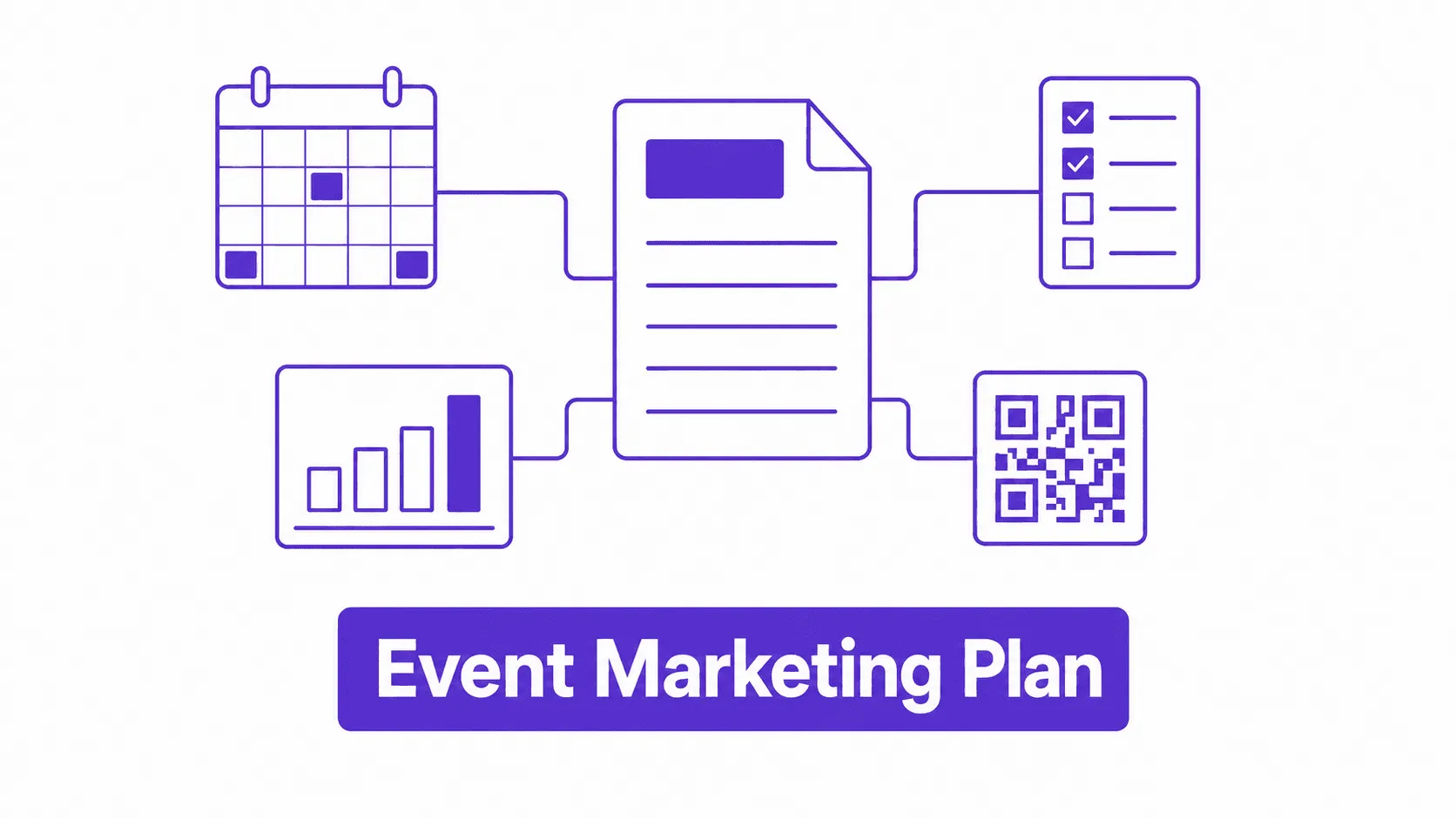
Event Marketing Plan: A Step-by-Step Guide + Free Template
In this article
- What Is an Event Marketing Plan?
- How Do You Set Goals, Budget, and Ownership Before You Build Anything Else?
- Who Is Your Audience, and How Do You Segment Them?
- Which Channels Belong in Your Event Marketing Mix?
- How Do You Build the Marketing Calendar?
- What KPIs and ROI Formula Should You Actually Track?
- What Happens On Event Day That Most Plans Never Plan For?
- How Do You Keep the Plan Working After the Event Ends?
- When Should You Skip Half of This?
- FAQs
What Is an Event Marketing Plan?
An event marketing plan documents four things: what you're trying to achieve, who you're trying to reach, how you'll reach them, and how you'll know it worked. That's the marketing strategy layer. Below it sits execution: a budget, a calendar, and a list of who owns what.
The plan is not the same as an event marketing strategy. Strategy is the "why": the reasoning behind targeting a segment, choosing a channel mix, positioning the brand. The plan is the "how": the document your team actually works from, with dates and dollar amounts attached.
A plan built around brand awareness alone tends to underperform. The plans that hold up connect every marketing action back to a business goal: pipeline, registrations, renewals, or a defined value proposition for a specific audience.
How Do You Set Goals, Budget, and Ownership Before You Build Anything Else?
Do this before touching a channel list.
Goals first. Pick one to two primary objectives: new pipeline, customer retention, product launch awareness, community growth. Every later decision (audience, channels, budget split) gets tested against these goals. A plan with five equally weighted goals is a plan with no goals.
Budget second. Set the number before you get attached to tactics. A common split for a mid-market B2B event: 40% paid promotion and content, 25% email and marketing automation, 20% event app and on-site tech, 15% held in reserve for the risks below. Adjust based on whether the event is prospect-facing or customer-facing. Customer events typically need less paid spend and more content/experience budget.
Ownership third, and this is the step most plans skip. Every task needs one name next to it, not a team name. "Marketing owns social" produces nothing on a Tuesday when nobody in particular is watching it. This is also where resource allocation gets decided: who has the hours, not just who has the title.
Build in a short risk and contingency pass here too: what happens if the keynote cancels, if registrations undershoot the target by 30%, if the venue WiFi drops. A two-line contingency note per major risk costs you ten minutes now and saves a scramble later.
Who Is Your Audience, and How Do You Segment Them?
Target audience isn't one line in the brief, it's a segmentation exercise. A single "event marketing plan" audience section that says "B2B decision makers" isn't specific enough to choose channels from.
Split your audience by at least two of these: role (economic buyer vs. influencer vs. end user), funnel stage (net-new prospect vs. active pipeline vs. existing customer), and event history (first-timer vs. repeat attendee). Demographics matter less here than intent. A repeat customer attending their fourth event needs a different message than a cold prospect deciding whether to show up at all.
This segmentation is what makes the channel and content decisions in the next section make sense. Skip it, and every channel gets the same generic message, which is the fastest way to a mediocre open rate.
Which Channels Belong in Your Event Marketing Mix?
Most plans default to "email plus social" because that's what's familiar, not because it's what the goal calls for. Match channels to the goal and audience segment you just defined.
Keyword research and basic SEO belong in this mix too, and it's the entity most "event marketing plan" content skips entirely. If your event has a public landing page, treat it like any other page: target the phrases your audience actually searches ("[industry] conference 2026," "[topic] summit"), not just your event's proper name, which nobody searches until they already know about you.
Your website or event page is the hub all of this points back to. Every channel above should drive to one URL, not a scattered set of registration links.
How Do You Build the Marketing Calendar?
This is where most plans become a static document nobody opens again. A marketing calendar needs three columns most templates skip: owner, channel, and status, not just date and task.
Map the calendar to the customer journey, not just to your internal deadlines: awareness touchpoints 8-12 weeks out, consideration touchpoints (agenda drops, speaker announcements) 4-8 weeks out, decision touchpoints (last-chance registration, what-to-expect emails) in the final two weeks, and a defined post-event touchpoint sequence.
Here's a ready-to-use Event Marketing Plan + KPI Tracker template to get started with. It's a working spreadsheet with the owner, channel, KPI target, and status columns already built in, so you're not rebuilding this structure from scratch.
What KPIs and ROI Formula Should You Actually Track?
"Track engagement" isn't a KPI. Name the numbers before the event starts, not after.
The formula most plans wave their hands past:
Event Marketing ROI = (Revenue Attributed to the Event − Event Marketing Cost) ÷ Event Marketing Cost × 100
If you can't attribute revenue cleanly, use a pipeline-influence version instead: partial credit to the event for any deal that touched an attendee during the sales cycle, rather than requiring a single-touch attribution model that will always undercount events.
What Happens On Event Day That Most Plans Never Plan For?
This is the gap. A plan can nail goals, budget, and channels, and still lose the ROI argument because nobody planned past the door.
Check-in is a marketing data point, not just an operations task. Manual check-in runs 45-90 seconds per person with a 15-20% error rate; app-based check-in with QR scanning brings that to 5-15 seconds per person with staff scanning, under 1% error rate, and throughput jumping from 40-80 people an hour to 240-400 (Nunify data across 200+ events). That speed matters for marketing specifically because 60-70% of attendees arrive in the first 30 minutes, and a slow check-in line is the first, and worst, impression your "brand awareness" line item makes all day.
A "QR code ready" reminder sent the morning of the event cuts that check-in time further, by 15-20% (Nunify data across 200+ events). That's a marketing email, not an ops task, and it belongs in your calendar.
The event app is a marketing channel most plans classify as a tool instead of a channel. Sponsor visibility, push notifications, and gamification all run through it, and gamification specifically is worth watching closely: if fewer than 30% of attendees engage with a challenge after the first hour, the mechanic is wrong for that audience and needs to change mid-event, not get reported as a failure afterward (source: Nunify data across 200+ events).
Sponsors deserve their own line here too. Sponsor visibility inside the app, booth traffic data, and lead capture are marketing deliverables you're promising a paying party. Treat them with the same planning rigor as your own registration goal.
How Do You Keep the Plan Working After the Event Ends?
The plan doesn't end at the closing keynote. Two things determine whether the event pays off in the following weeks: how fast leads get worked, and whether check-in and engagement data actually make it into your CRM.
Check-in and app engagement data (who attended, which sessions, how long they stayed, which sponsor booths they visited) is first-party data your paid retargeting campaigns almost never have this cleanly. Feed it into a retargeting audience and a personalized follow-up sequence, and you've turned event-day operations data into next-quarter's pipeline.
Feedback and post-event surveys close the loop back to your original goals: did the people you targeted actually show up, and did they get what they came for. Skip this and your next event's plan starts from a guess instead of a fact.
When Should You Skip Half of This?
Not every event needs the full version of this plan, and pretending otherwise wastes time you don't have.
Under roughly 50 attendees with no badge requirement, a shared spreadsheet and a greeter at the door is genuinely fine. Don't build a KPI dashboard for a 30-person internal lunch-and-learn.
Above 75 attendees, the math flips: the operational cost of a manual, unowned process (chased emails, an unmonitored check-in line, no post-event data) starts costing more in staff time than a proper plan would have taken to build (source: Nunify data across 200+ events). Worth checking these event apps compared with real pricing inside to build your shortlist.
If your event has no external audience and no revenue goal attached (a pure internal town hall, for instance), you can drop the ROI formula and CPL tracking entirely. Keep attendance rate and feedback. That's honest scoping, not corner-cutting.
FAQs
Strategy is the reasoning: which audience, which goal, which positioning. The plan is the execution document with dates, owners, and dollar amounts attached to that reasoning. You need both, but they're not the same artifact.
For a mid-size B2B event, start 8-12 weeks out for awareness activity, with the full plan (goals, budget, owners, calendar) locked before that window opens. Smaller internal events can compress to 3-4 weeks; anything requiring sponsor coordination needs more runway, not less.
It varies widely by event type, but marketing typically runs 10-30% of total event spend for external, revenue-driving events, trending toward the lower end for repeat/customer events and the higher end for first-time or prospect-acquisition events.
A lighter version, yes. Keep goals, an owner list, and attendance tracking. Drop the ROI formula, CPL, and paid channel planning. See the skip-this section above.
At minimum: an email platform, a shared calendar with owner columns, and a registration/check-in system that exports attendance data somewhere your team can actually use it. The event app becomes worth adding once you're past roughly 75 attendees, based on the check-in math above.