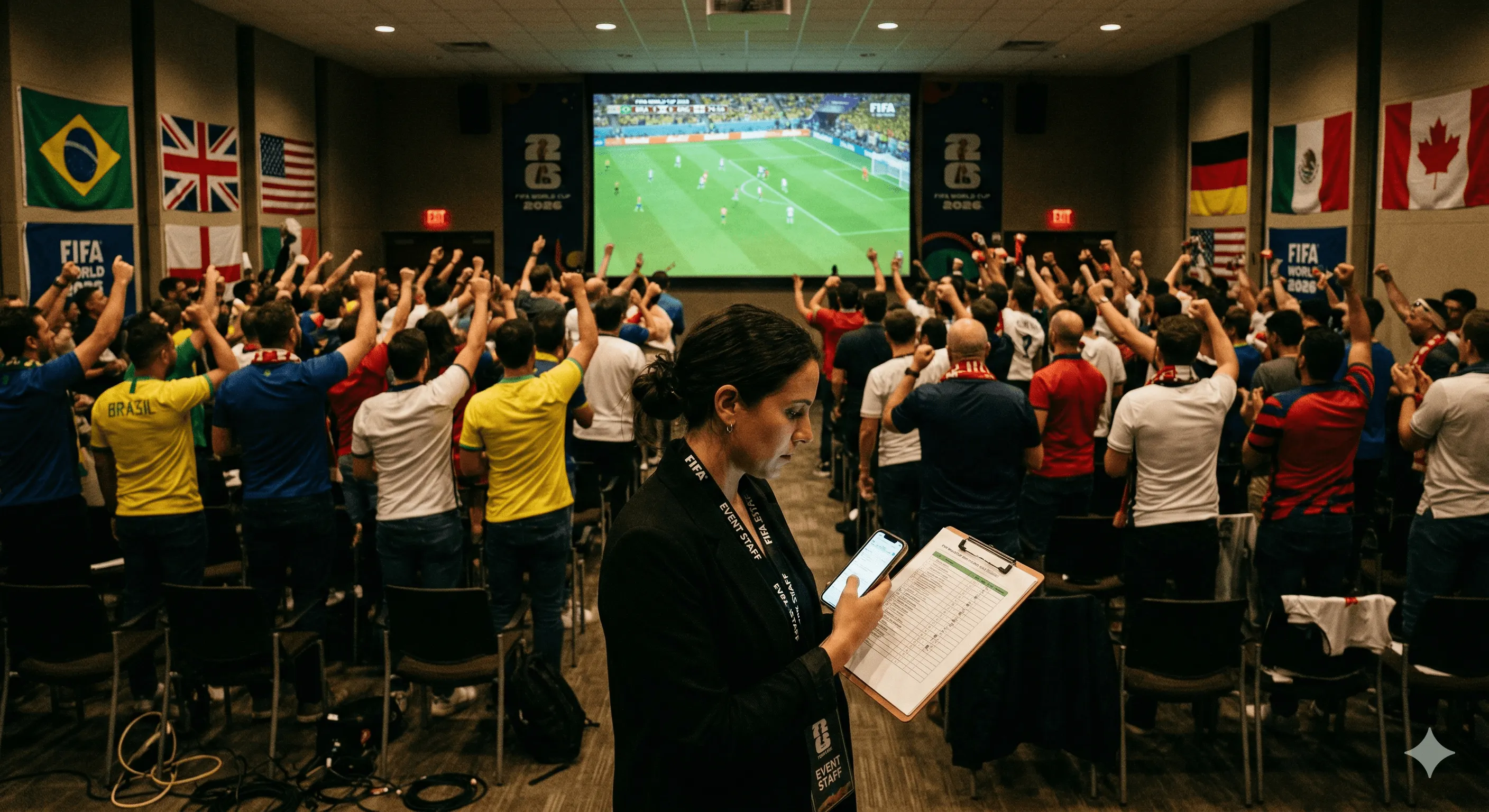
A corporate FIFA watch party isn't a home viewing party. It isn't a stadium experience. It sits somewhere in between — a professional gathering with the energy of a live tournament moment.
That means the stakes are different. The food, the atmosphere, the space, the experience all need to hold up in a work context while still feeling like a genuine celebration of one of the world's great sporting events.
The challenge most corporate planners underestimate: a FIFA World Cup match has a fixed kickoff. There's no flexibility. Unlike a conference or a networking event, the moment is the thing. Everything — the venue setup, the food, the check-in, the atmosphere — needs to be ready before the ball moves.
FIFA 2026 Watch Party Theme Ideas for the Office
"Make it fun" is not a brief. You need a concept — something that makes the event feel intentional rather than a TV on a wall with some snacks.
Here are four themes that work in a corporate setting.
The Hometown Bracket
Divide your team across the 48 qualifying nations competing in the 2026 FIFA World Cup tournament. Assign teams randomly. Suddenly the CFO is Argentina and the intern is Saudi Arabia. Everyone has a stake in the tournament. It costs nothing and creates genuine energy throughout the competition.
Add a prize for whoever's team goes furthest — a day off, a gift card, bragging rights. The bracket becomes a conversation that runs for weeks.
The Flag Wall
Print flags from all the nations competing in the 2026 tournament. Let people claim their country on a physical board. The flag wall becomes the visual centrepiece of the event space and doubles as a talking point for people who don't follow association football closely.
Works especially well in offices with international teams — the United States, Mexico, Canada, and European nations all have strong representation in the 2026 FIFA World Cup.
The Street Food Menu
One dish per match. Brazil plays, you serve coxinha. Mexico plays, you serve tacos. United States plays, you serve sliders. The food menu becomes a global tour that tracks the tournament.
This approach makes the catering feel intentional rather than generic. It also gives you a natural conversation starter — people will talk about the food, the countries, the teams.
The Jersey Rule
Simple dress code: wear the football jersey of the country you're supporting. No jersey, wear office colors. It requires no budget and creates instant atmosphere. The room looks like a real fan experience rather than a meeting that ran late.
Venue and Space
Size Your Space for Reality
The single biggest mistake corporate planners make: booking for the wrong number of people.
They book big because they're nervous about looking cheap. Then 40% of RSVPs don't show up and the room looks half empty. An empty room kills energy faster than anything else. A packed smaller space feels electric. A half-empty big one feels like a failure even if the event itself is fine.
Nunify platform data across corporate events shows that weekend events consistently see 30–40% of confirmed RSVPs not show. They meant to come. Life happened. Book your venue for 65–70% of your confirmed RSVP count — not 100%.
Screen and Sightlines
Every seat needs a clear view of the screen. For a FIFA World Cup match, the screen is the entire point of the gathering. If people can't see the association football action clearly, the event fails regardless of everything else.
For groups over 50, a single large screen or LED display is essential. For larger groups, consider multiple screens positioned around the space so no area of the room has a blocked sightline.
Lighting and Atmosphere
Overhead office lighting kills tournament atmosphere instantly. Dim it. Add some directed lighting toward the screen. If you have the budget, colored lighting in national colors adds to the stadium feel.
The goal is to make the space feel different from a regular workday. Atmosphere is mostly lighting and sound — two things that cost very little to adjust.
Food and Drink
Finger Food Only
Corporate catering defaults are wrong for a watch party. Plated food during a live association football match means people are juggling plates while trying to watch. Fork-and-knife anything is the wrong call.
Rule: if it requires cutlery, cut it from the menu.
What works: sliders, nachos, chicken skewers, spring rolls, cheese boards, charcuterie, mini sandwiches, anything people can eat standing up or in one hand without looking down.
Drinks
Beer, soft drinks, cocktails, and non-alcoholic options. Keep it simple and keep it accessible. A self-serve drink station with ice, bottles, and clear labeling works better than a formal bar setup for a watch party format.
If you want to tie the drinks to the tournament, a caipirinha station (Brazil), margaritas (Mexico), or a drinks menu themed around the competing nations adds to the experience without requiring a professional bartender.
Order for 70%, Not 100%
Apply the same logic as your venue sizing. Order catering for 65–70% of your confirmed RSVPs. The no-shows are coming whether you plan for them or not. Your budget shouldn't suffer alongside them.
Logistics: What Goes Wrong and How to Prevent It
The Stream
This is the highest-risk element of any corporate FIFA watch party. A dead stream at kickoff is unrecoverable.
Test the stream the day before. On the actual screen. In the actual venue. On the actual wifi. Not on your phone, not at home — there, in the space, on the equipment you'll be using. If the venue's wifi can't handle a high-definition broadcast of a live association football match, get a backup. A mobile hotspot. A secondary streaming source. Something.
There is no recovery from a dead stream at kickoff.
Check-In
A FIFA World Cup match has a fixed kickoff time. Everyone arrives in the same 20-minute window. If you're checking people in from a printed list and a highlighter, you've created a queue that punishes people for showing up on time.
With digital check-in and on-site badge printing, average check-in runs 20–40 seconds per person. With a spreadsheet, that number climbs to 3–5 minutes. At 150 people arriving in a 20-minute pre-kickoff window, the difference between those two approaches is the difference between a smooth arrival experience and chaos before the tournament even begins.
Have a separate protocol for walk-ins — the 10–15% of people who heard about the event and show up unregistered. Designate someone to handle walk-in registrations away from the main check-in flow so they don't slow down everyone else.
Comms
You'll send one email. Maybe two. Most people won't read them properly. Send a hard confirmation 48 hours before the event — not a reminder, a direct question: "Are you still coming? YES or NO." The people who ghost that message were probably not coming. That silence is useful data for your final headcount.
Post-Event
Your leadership team will ask how it went. "It was great" isn't an answer. They want to know how many people came, what it cost per head, and whether the investment was worth it.
If you ran the whole event from a spreadsheet and a group email, you have no data. Capture actual attendance — not just RSVPs — so your post-event report reflects what actually happened rather than what you hoped would happen.
Attendance rate figures from Nunify platform data across corporate events. FIFA 2026 economic projections from FIFA/CNN (March 2025). Hotel demand data from Lighthouse via Sodexo (2025). Luxury hospitality pricing from Sports Business Journal via On Location.